Professional Web Development with Delphi and Dext Framework: From Vision to Solid Ground
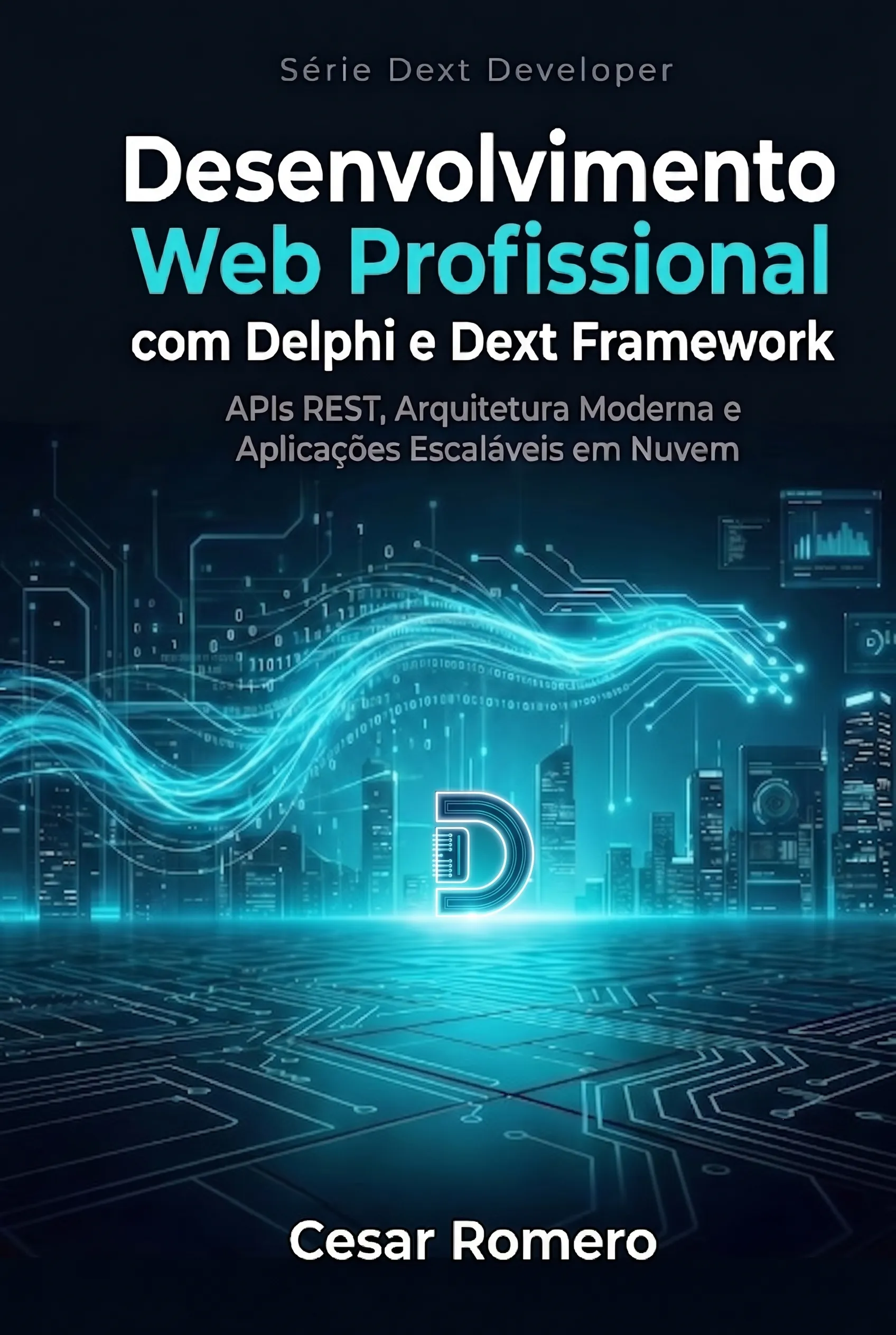
This book did not begin at an editorial desk. It started with a healthy dose of envy.
For years, I wrote frameworks in Delphi. It was almost always the same ritual: build an ORM, stretch it into desktop, ERP, three-tier architectures. In daily routines, it was productive. Deep down, a lot was missing. I pursued what was lacking — dependency injection, unit testing, MVC-style UI separation — yet it still wasn’t quite right. It remained “my personal way of structuring a Delphi project.” It was not how the rest of the software engineering industry spun up a production service and went to sleep with peace of mind.
Back in 2016, I was immersed in major migrations from Java to Go. The simplicity hit hard. Little ceremony, native concurrency, and code you read on Monday and still understand on Friday.
By 2018, I dove headfirst into other stacks, especially .NET. That was when things got personal. Bootstrapping a solid Web API with architectural standards, database mapping via LINQ, full test suites, and CI/CD deployment pipelines… in less than an hour, the foundation was already committed. Achieving the equivalent in Delphi back then took days. Not because Object Pascal was slow — on the contrary, the compiler has always been a beast —, but because the foundation didn’t exist. Every component was an isolated library, a different paradigm, another “we’ll patch it together later.”
The Search for Solid Ground
Section titled “The Search for Solid Ground”Around that time, Clean Architecture landed in my hands. I devoured it. For the first time, someone laid out a crystal-clear map of what I had been searching for in the dark. I began to deeply study the architecture of global enterprise frameworks — and since .NET is open source, I read how features were conceived, not just surface-level tutorials.
Then the dream was born: what if this existed natively and cohesively in Delphi?
I tried. Multiple times. But I could never complete a full project with the same seamless flow. To deliver significantly less than what I could build in .NET, I had to juggle twenty-five disparate dependencies. So I stopped collecting pieces written by others and began crafting the missing piece myself. No rushing. No product deadlines. Wherever curiosity led me: Python, Node, Flutter, more .NET internals, more production battle scars.
The prototype grew quietly in the background. Many developers saw glimpses of it without realizing it: talks at Embarcadero Conference, CodeRage, Delphi Boot Camp, ITDevCon. I would present a cutting-edge topic; underneath, another brick of the framework was being laid.
The desire to write a comprehensive web development book around this vision kept growing. So did the drafts. And those drafts kept dying, because the underlying foundation could not yet support the book’s ambition. Last year, after releasing Delphi Multithreading, I made a definitive decision: invert the order. Solid ground first, text second. I focused entirely on polishing the framework until it became the exact foundation I wished I had in 2018 — enriched with years of production experience, including the fact that we are launching this in the era of autonomous AI agents.
Dext Framework was born from a personal vision, but it quickly became an urgent need for the entire Delphi ecosystem. The community needed a modern, cohesive, and unified ecosystem — without hunting down dozens of disconnected third-party packages — to build cloud-native enterprise backends that are simple to start and blazing fast to run. Pure Object Pascal, native compilation, zero pretense.
The culmination of this journey is the first volume of the series: Professional Web Development with Delphi and Dext Framework.
What the Book Is (and What It Isn’t)
Section titled “What the Book Is (and What It Isn’t)”- Not a basic syntax guide: Assumes you already know Object Pascal.
- Not traditional VCL: If you are looking to drag-and-drop components onto forms or generate quick reports in a DataModule, you will find this book deep and rigorous — and that is by design.
- Real-World Concurrent Web: Stateless services, high-throughput HTTP, real concurrency, Linux containers, and clean architecture.
To prevent this from being a dry feature catalogue, we build a real-world enterprise product from scratch: Dext Billing (Dext Faturamento). It begins as a simple balance query API and progressively scales into a full-fledged system with multi-tenant isolation, JWT authentication, role/authority matrix, Background Jobs, Redis, Hubs/WebSockets (SignalR), Docker, gRPC, and exposure as AI Agent tools (strictly governed by domain business rules, without letting LLMs invent arbitrary SQL).
Includes 5 Hands-on Labs, complete GitHub repository, .http files for instant endpoint testing, and automated test suites.
Inside the Book: The Four Iterations
Section titled “Inside the Book: The Four Iterations”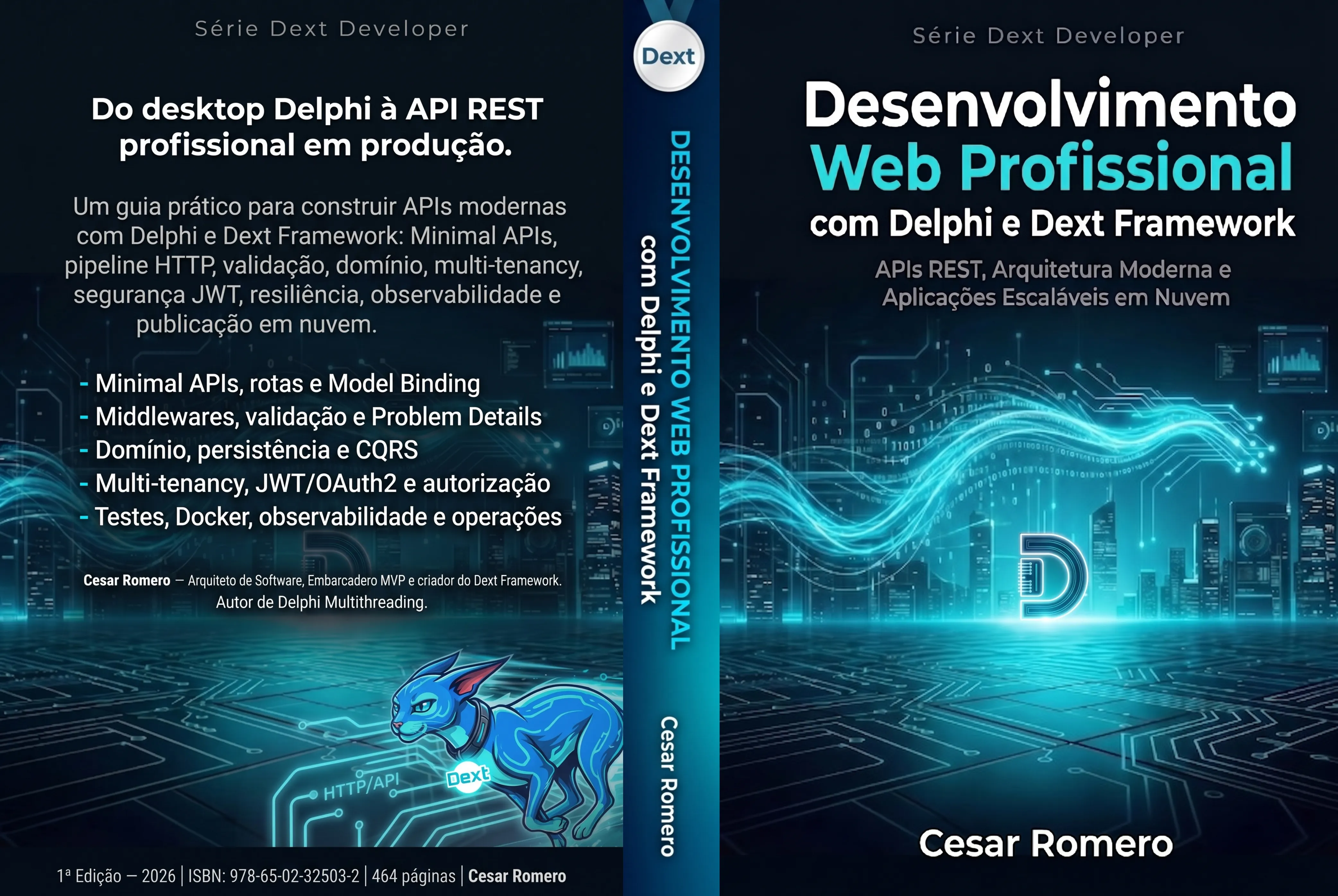
🔄 Part I: From Form to HTTP
Section titled “🔄 Part I: From Form to HTTP”Shifting from desktop mindsets to modern HTTP protocol standards. Fluent routing, Minimal APIs, strongly-typed parameter binding, middleware pipelines, and structured error handling using RFC 9457 (Problem Details).
Lab 1: Building the Customer API.
🔄 Part II: Architecture and Persistence
Section titled “🔄 Part II: Architecture and Persistence”Twelve-Factor configuration via environment variables, practical comparison between Controllers and Minimal APIs, the power of Dext Entity, Smart Properties, and the Specification Pattern for decoupled queries.
Lab 2: Billing domain with robust database persistence.
🔄 Part III: Enterprise Domain and Security
Section titled “🔄 Part III: Enterprise Domain and Security”CQRS in practice, secure Multi-Tenant isolation, governed Database-as-API, authentication & authorization with JWT/OAuth, permission hierarchies, caching strategies, and rate limiting.
Lab 3: A resilient multi-company SaaS that guarantees zero cross-tenant data leakage.
🔄 Part IV: Resilience, Operations, and AI
Section titled “🔄 Part IV: Resilience, Operations, and AI”Asynchronous processing with HTTP 202 Accepted, Prometheus metrics, automatic OpenAPI/Swagger specs, reactive UIs with HTMX, ultra-high performance communication via gRPC, automated testing, Docker containerization, and exposing APIs tailored for AI Agents.
Labs 4 & 5: Complete system integration.
Who This Book Is For
Section titled “Who This Book Is For”- Delphi Developers who make their living with Pascal and don’t want to abandon the language or migrate to C#/Java just to build modern backends.
- Software Engineers who have experienced other modern stacks (.NET, Go, Node, Python) and miss Delphi’s raw compilation speed, type safety, and native performance, without sacrificing modern architectural patterns.
- Attendees of my conferences and workshops over the years who continually asked: “Where can I find the book that brings all of this together?”
Where to Get the Book
Section titled “Where to Get the Book”-
Printed Edition in Brazil (UICLAP):
Order on UICLAP -
Amazon Global (Paperback):
Order on Amazon.com
(Availability on Amazon regional storefronts is propagating). -
Digital Edition (Amazon Kindle):
Order on Amazon (Kindle eBook)
(Regional storefront propagation in progress). -
English Edition: In final review stages.
-
Hands-on Labs Source Code Repository:
github.com/dotpas/book-dext-web
Explore More in the Dext Ecosystem
Section titled “Explore More in the Dext Ecosystem”Dive deeper into the components and architectural design featured in the book via the official docs and deep-dive technical articles:
- Official Dext Repository: github.com/dotpas/dext
- Complete Technical Documentation (Dext Book): Guides & Specs
- Article on Strongly-Typed Validation: Fluent Validation API in Dext
- Article on Observability & Telemetry: Unified Telemetry with OpenTelemetry & SigNoz
- Article on Native S43 Architecture: TLS/SSL Cryptography and High Performance
Cesar Romero · 1st Edition, 2026 · ISBN 978-65-02-32503-2